
From Guesswork to Flow
Rethinking Capacity in Modern Enterprises

Introduction
Imagine walking into a business where roadmaps, forecasts, and capacity planning aren’t points of tension, but natural, almost invisible parts of how work gets done. That world might feel like a fantasy. This article doesn’t promise silver bullets for complexity, but perhaps it offers a brass one: practical, durable, and effective.

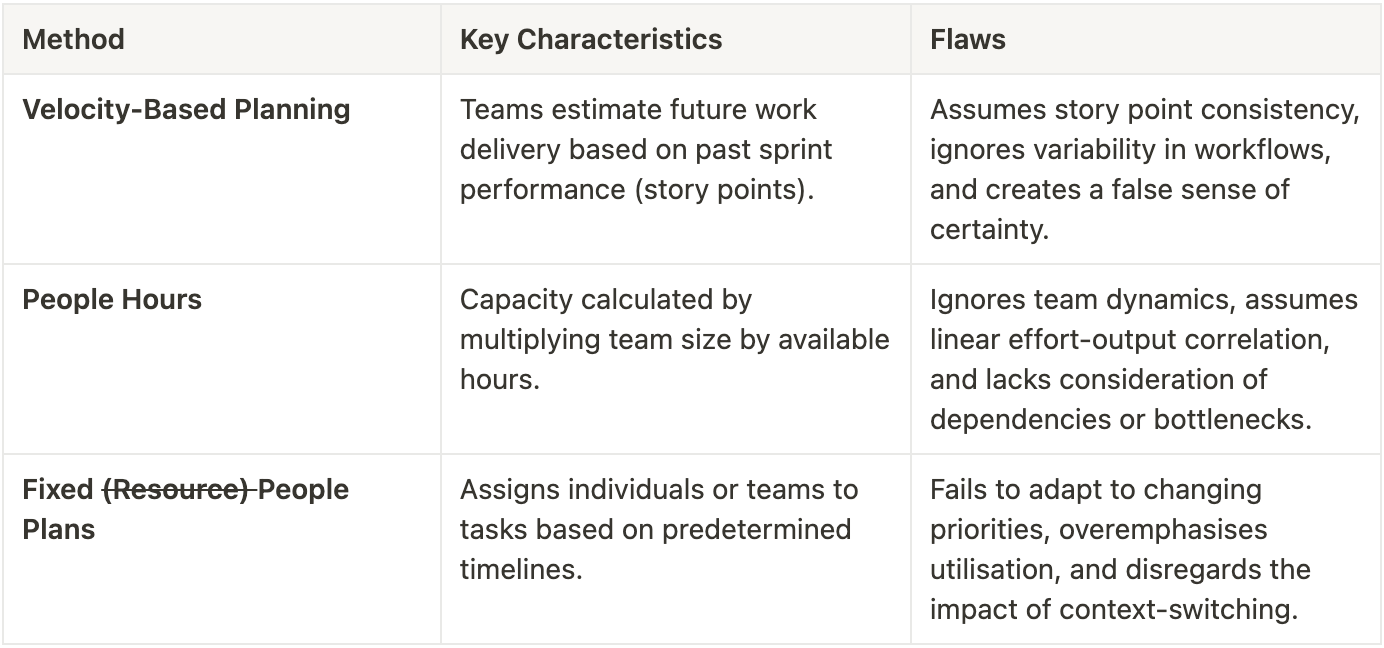
Traditional capacity planning often relies on outdated paradigms, deterministic forecasts, velocity charts, and hours-based allocations. These crumble under the weight of modern knowledge work, where timelines are rarely linear and assumptions are easily broken.
Instead, we can reframe capacity through flow-based metrics. At the centre is Little’s Law, which provides a stable long-term perspective. Complementing it is probabilistic forecasting (e.g. Monte Carlo simulation), which translates variability into actionable predictions in the short term.
Premise & Purpose
Premise
This approach applies to any team delivering value, whether through operational work or product development. It assumes stable workflows and reliable historical data.
Purpose
Build a shared understanding of capacity across teams and value streams.
Enable sanity checks on whether strategic decisions are feasible.
Support clear communication of capacity insights across the business.
Why Traditional Capacity Planning Falls Short
Capacity planning by people-hours or velocity is deeply ingrained in project management. But in complex environments, these methods almost always fail:
Poor decision-making — leaders and product owners can’t prioritise effectively.
Mistrust and missed deadlines — overpromising erodes stakeholder confidence.
Reduced agility — rigid plans lock teams into commitments that reality quickly invalidates.
The Flow-Based Alternative: Little’s Law
At its heart:
L = λ × W
L: Average work in progress (WIP)
λ: Average throughput (items completed per unit time)
W: Average cycle time (time per item)
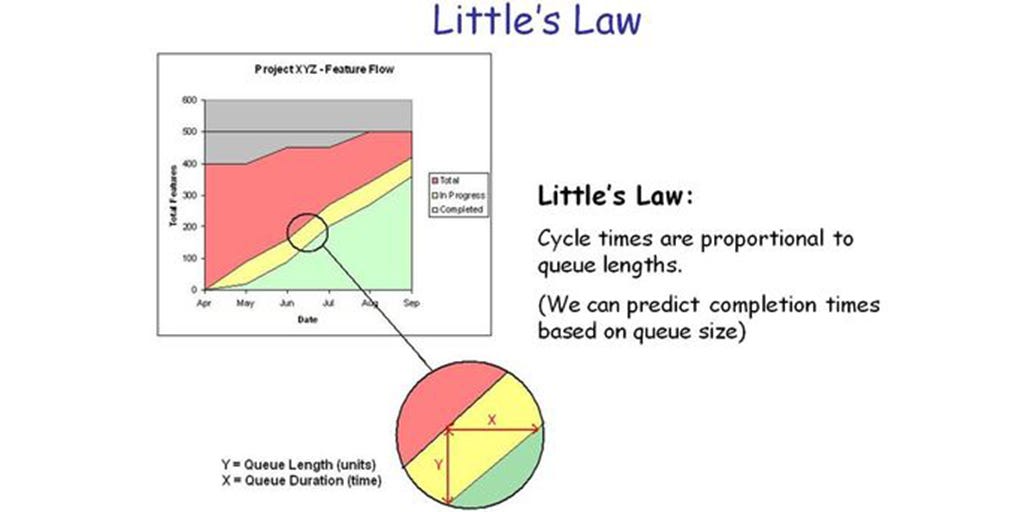
By focusing on how work actually flows, not how we wish it would, Little’s Law gives a consistent measure of capacity.
But… assumptions matter:
Work entering and leaving the system must be stable.
WIP, throughput, and cycle time need clear definitions.
Too much rework breaks stability.
If these assumptions don’t hold, Little’s Law loses its grounding.
A Simple Example
Imagine a high-street retailer: 100 customers arrive per hour, each spending 30 minutes in the shop.
L = λ × W = 100 × 0.5 = ~50 customers at any time.
The same logic applies to knowledge work — helping teams see their true “shop floor” capacity.
Macro and Micro Views
Macro View
Use historical data to “t-shirt size” larger initiatives (e.g. epics or features). This gives strategic decision-makers a sense of feasibility over longer horizons. For instance, using 2024’s data to gauge what might be possible in 2025.

Micro View
At the team level, measure throughput (work items finished per time unit). This grounds the macro perspective in actual performance.
Why Probabilistic Forecasting Complements Little’s Law
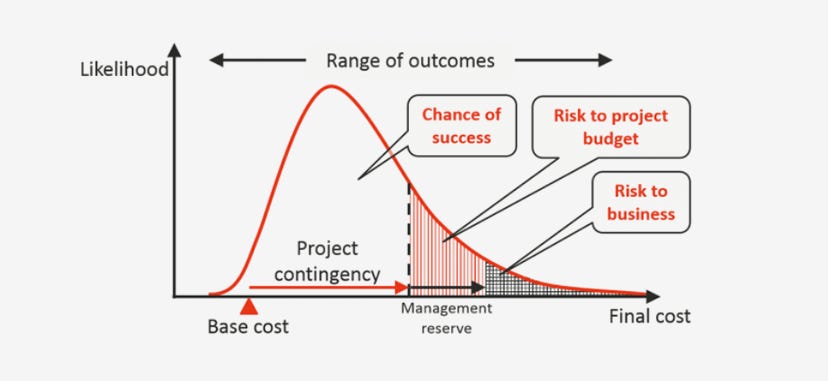
Little’s Law is great for understanding capacity in a steady state. But when leaders need forecasts for the delivery of specific work, probabilistic methods step in. Monte Carlo simulations, for example, use actual data to provide likelihood-based answers (“80% chance this feature will complete in X weeks”).
This shifts the conversation from certainty theatre (“We’ll deliver by date X”) to credible probabilities, a more honest and agile way to plan.
Real-World Application
Enterprises managing multiple value streams can:
Apply Little’s Law to establish baseline capacity and align strategy.
Use probabilistic forecasting when a high-priority initiative arises, providing realistic delivery windows.
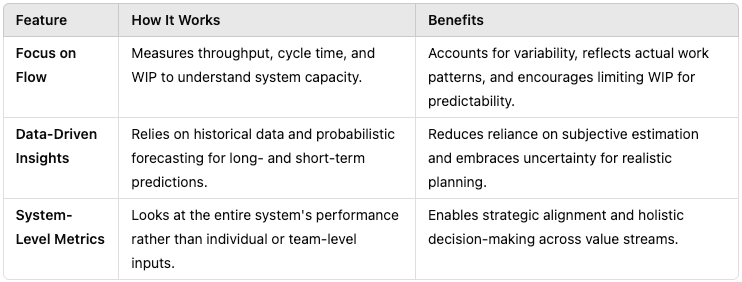
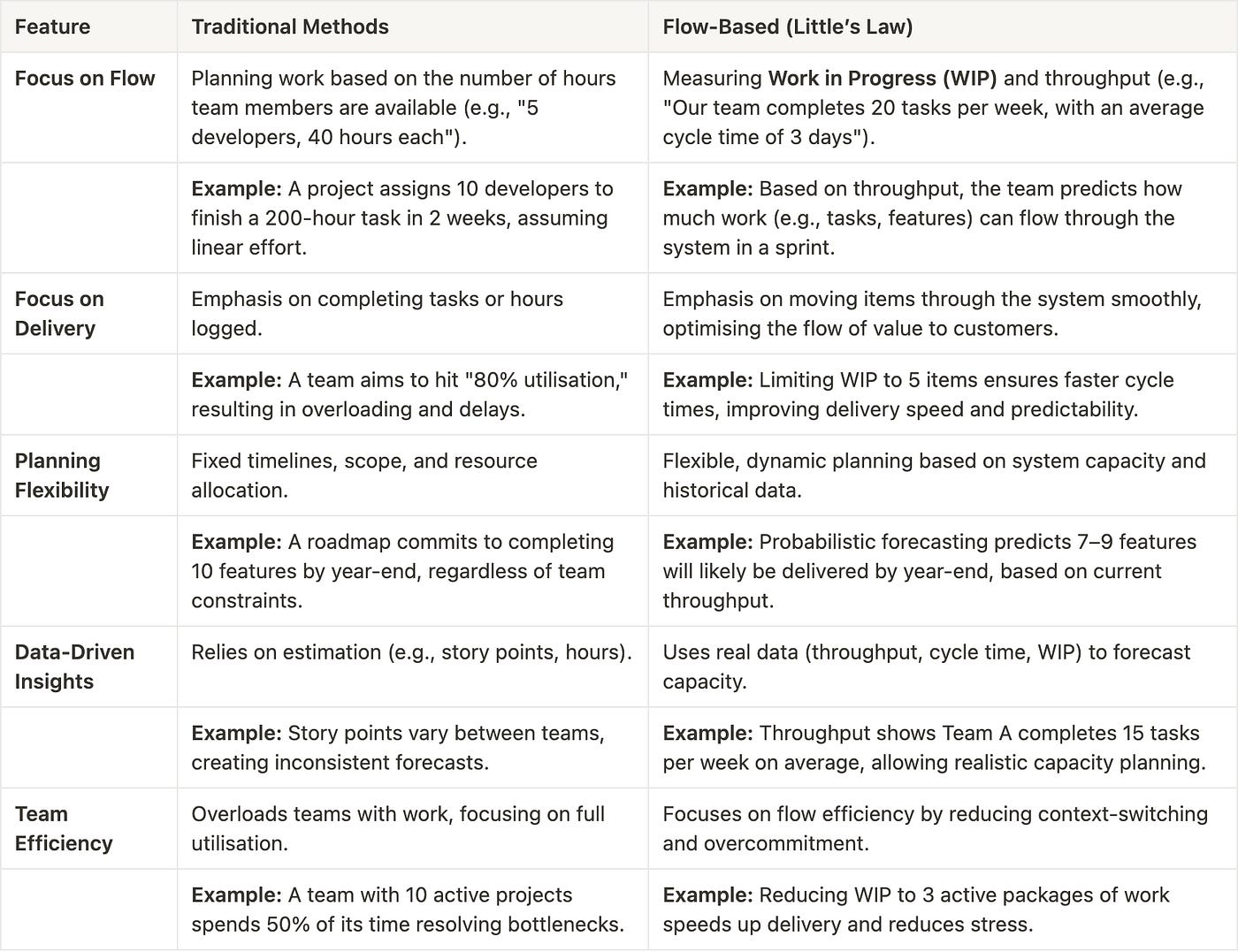
Agility without sacrificing predictability or credibility - comparison below between methods.
Toward Smarter Decision-Making
Moving from velocity and hours to flow-based metrics is more than a technical shift; it’s a cultural one. By embracing flow, organisations gain:
Realistic capacity views are grounded in system behaviour.
Flexibility to adapt through probabilistic forecasting.
Alignment across teams and value streams.
In today’s landscape, agility isn’t just about speed. It’s about making better decisions with better information, and Little’s Law, combined with probabilistic forecasting, is a pragmatic brass bullet.