

Lidl Opportunities
Let’s face it, there’s a moment in every trip to Lidl that turns an otherwise smooth experience into chaos… the checkout.

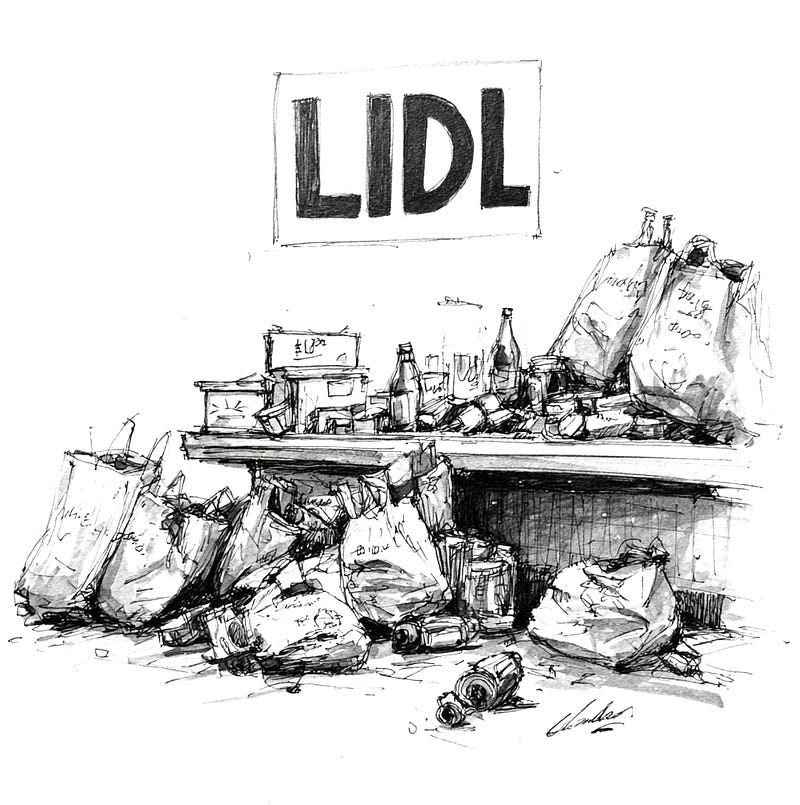
The shelves are stocked, the prices are sharp, the “Lidl Middle Treasures” keep you browsing at rubbish you don’t need, and then, as you reach the till, the entire flow breaks down.
By design, the packing area is deliberately short. You don’t get space to calmly arrange your items. Instead, you’re forced into a race against the cashier (if you don’t have the modern-day norm of self-scanning). And this isn’t just perception — multiple Reddit threads confirm that Lidl team members are focused on checkout speed. Originally, tills were expected to process 35 items per minute; more recently, some stores report an updated figure of 27 items per minute.
Think about that: less than two seconds per item.
That number might make sense if all that mattered was a metric on a dashboard. However, it fails to consider the system within which it sits.
What’s funny is you have investment from the people (team members) going to the length of identifying workarounds of till procedures or “hacks” to meet the target, still absent from the impact to the customer.
Let's break this down into areas of focus.
The Packing Paradox
Who doesn’t try to pack their trolley with some logic and preparation: heavy at the bottom, fragile at the top, chilled together, cupboard staples together. It’s a kind of unconscious silent choreography aisle by aisle.
But as soon as items start flying across the scanner at n+ per minute, all that order is lost, and we find ourselves in disorder.
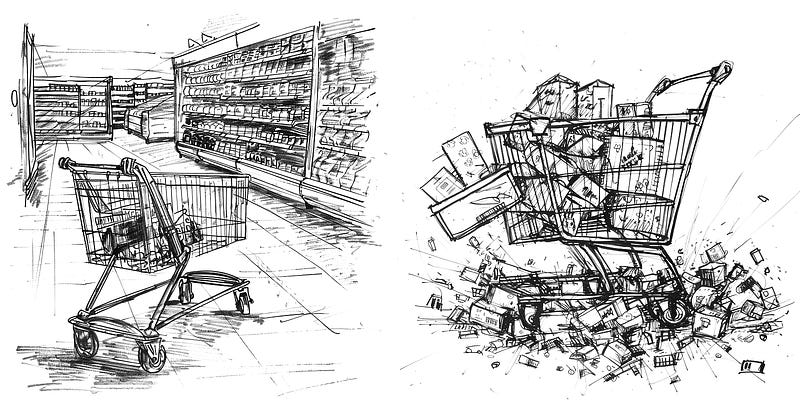
The carefully prepared flow is replaced by scrambling with the events of Reaching for the item, Pick up item > Look at trolley > Look at bags > Make informed judgment of which bag it belongs in > Move item into Bag & Repeat.
It’s not uncommon to fall behind, forced to pile items randomly, undoing the effort of packing logically in the first place. The result? A trolley that takes twice as long to sort at the car (+home) and a customer experience that leaves you feeling hurried, frustrated and worse off than you came in.
Sometimes, I even slow down on purpose or tactically place items needing weighing in part protest, part hope that the cashier might see the bottleneck they’re creating. (Of course, they don’t — they then see you as a frustration).
The bottleneck (no one sees)
Here’s the irony: every scan might look like progress, but the real constraint in the system isn’t scanning — it’s packing.
The throughput of the entire experience is dictated not by how quickly an item crosses a red laser, but by how quickly it finds its way into a bag.
And when measurement focuses only on the first step, the whole system suffers.
This is a perfect example of what Lean thinkers would call a bottleneck. By optimising one stage (scanning speed), a congestion occurs in the very next stage (packing). The faster the input, the worse the blockage.
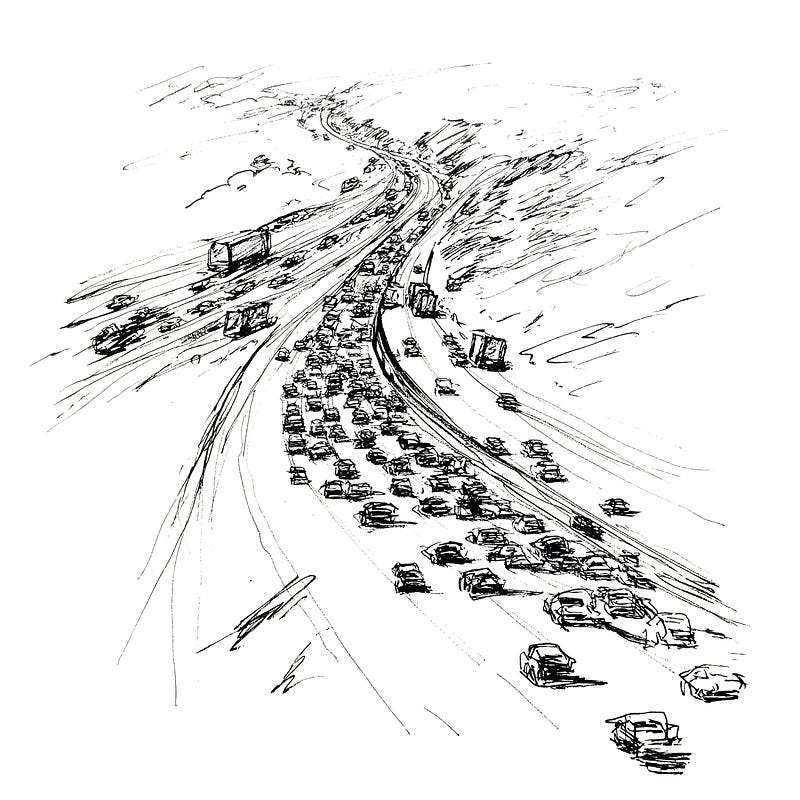
It’s like widening a motorway exit lane to feed into a single narrow slip road. You’ll move more cars into the jam, but you won’t clear it faster.
When targets make you stupid
This is what happens when a system has a narrow focus on a single metric.
“Items scanned per minute” looks efficient on a report ✅ - It’s a clean, countable number that has been rationalised. But it tells you nothing about the customer experience and broader opportunities.
It blinds you to other, more meaningful outcomes:
Did customers feel calm and in control?
Did the customer leave happier than when they entered?
Will they want to return next week?
Broken and or dropped items due to panic?
In this instance, Lidl are optimising for something which has an invisible roadblock. Without a feedback loop, there can be no learning. And without learning, there can be no continuous improvement.
As a customer, my “Gemba walk” — going to the place where the work happens, and observing — showed me this: Lidl has no standard for enabling flow across the whole checkout experience. The standard ends at scanning, and everything downstream is chaos.
It’s clear we as humans are blind to opportunity if we merely execute. I would ask:
If Lidl Managers carried out their own “Gemba”, would they see this opportunity? Or what if a “Feedback Post” was positioned upon walking out of the supermarket, would this enable a feedback loop for insight and analysis?
A Thought Experiment
What if Lidl looked beyond the scan and introduced a new standard? Not just how fast items are scanned, but how effectively the customer can pack at a sustainable pace.
What if staff were not targeted on scanning speed and were empowered to balance speed with flow, even adapting their pace to match the customer’s? (Some do this already, driven by age primarily from observations.)
Would customer satisfaction increase? Almost certainly.
Would the likelihood of return rise? Highly likely.
Would staff morale improve? Undoubtedly, fewer frowns were directed their way.
Real flow is not about maximising one part in isolation. It’s about creating balance across the system, and the end-to-end journey matters more than the single point of measurement.
Lidl Opportunities
Lidl is one of the fastest-growing grocery chains in Europe and the UK. Its lean, low-cost model is delivering enormous success. Why should they care about whether my eggs and bread get crushed at the checkout?
The cone of uncertainty applies perfectly here. The outcome is not in doubt: every item will eventually make its way into a bag. What’s uncertain is the journey. Will those items arrive in a way that feels calm, logical, and with the order you intended — or will they arrive rushed, scattered, and frustrating?
That difference doesn’t come from the destination, but from the system that governs how you get there.
The opportunity here isn’t just for Lidl; it’s a wider lesson.
When we reduce performance to a narrow target, we risk creating dysfunction elsewhere. When we optimise for one measure, we can damage the whole, and that success today should not excuse us from noticing friction and designing for flow. Whether in retail, software, or any other system, the question isn’t just “are we growing?” but “are we learning?” Growth without learning drifts into fragility.
If organisations created measures that captured that bigger picture, they wouldn’t just improve metrics. They’d improve experiences, loyalty, and overall trust.
This post is part of a series on everyday flow observations, exploring how the principles of Lean, Systems Thinking, and continuous improvement manifest in daily life, from supermarkets, travel, and cycling to work.
Because flow is everywhere if you choose to look 👀.